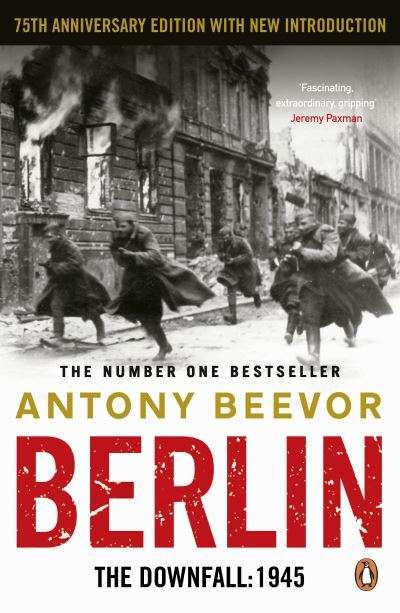
United Kingdom
"In Stalingrad Beevor gave us a riveting account of that crucial fearful battle, when Hitler’s forces met their match. . . Beevor deploys the same successful techniques in Berlin. He combines a soldier’s understanding of war’s realities with a novelist’s eye for symbolic and emotional detail. Nobody will forget the artillerists who kept their mouths open to stop their ear drums bursting as they fired their guns; the little boys in Landsberg who played war games with wooden swords amid the bombed-out ruins of their house; or the rhododendrons that were coming into bloom as mortar-fire rained down on Berlin, darkening the street with smoke and dust. Beevor paints a terrifying picture."
- Orlando Figes The Sunday Times
"This is a powerful, diligently researched and beautifully written book, even better, in my view, than Stalingrad. Since that book scooped almost every award it is hard to know how the literary establishment can deal with Beevor’s latest success."
- Andrew Roberts The Mail on Sunday
"It is taking a new generation of historians to fill in the gaps. Antony Beevor’s award-winning book Stalingrad dug out human drama from the once inaccessible archives and wove it into a riveting tale of awesome brutality. Now, in Berlin, Beevor offers us an equally dreadful picture of the European war’s savage last gasp. Even composed readers might find themselves turning the pages with open mouths. . . Beevor has done it more than justice. He wisely does not attempt to compete with his dreadful material, so his book is a powerful anthology of anguished utterances. Anyone who thinks they have had a bellyful of war stories had better think again. Don’t mention the war? Don’t ever forget it, more like."
- Robert Winder The New Statesman
"This brilliant storyteller. . . makes us feel the chaos and the fear as if every drop of blood was our own: that is his gift. It is much more than just a humane account; it is compellingly readable, deeply researched and beautifully written."
- Simon Sebag Montefiore The Spectator
"In many respects, Beevor’s latest book is like Alexander Solzhenitsyn’s epic narrative poem Prussian Nights, albeit with footnotes to impressive sources. . . As a former army officer turned historian, Beevor gives an exceptionally clear account of complicated military movements and the reasoning of the commanders responsible for them. But he is also sensitive to the real casualties of war. Boys whose anxious faces disappeared within man-sized helmets; women who managed to feed their babies between multiple gang-rapes; and elderly folk who found themselves in the midst of hell because they were loath to leave a family farm or a spouse’s grave. The result is a masterpiece of modern historical writing."
- Michael Burleigh (author of The Third Reich) The Guardian
"As in his Stalingrad, Antony Beevor skillfully combines the big picture of the developing strategic situation with a sense of the extraordinary experiences on the ground . . . The strength of Berlin: The Downfall 1945 is an irresistibly compelling narrative, of events so terrible that they still have the power, more than half a century on, to provoke wonder and awe."
- Adam Sisman The Observer
"A compelling piece of historical description and assessment, the more important because some of Beevor’s Russian archival sources may not be available in future"
- Alan Judd The Daily Telegraph
"Antony Beevor brings vividly alive the final days of the doomed metropolis. Digging deep into Soviet files, personal diaries and memoirs, he applies the same technique as he deployed so successfully with his bestselling book on Stalingrad to give us the human face of a savage and pitiless war. . . It’s in his eye for the telling detail about ordinary people and soldiers caught up in the maelstrom of defeat that Beevor so magnificently captures the true pity of war."
- David Stafford The Evening Standard
"This superlative work exerts a narcotic effect. It plays outlandish games with the emotions. There can be few other books that have propelled the reader through such a whirlwind of sadism, lust, avarice, stupidity and madness, yet left him or her abjectly grateful for the experience. It is an education."
- Cal McCrystal The Independent on Sunday
"This is a stunning exercise in historical writing."
The Daily Express
"Antony Beevor, who gave us the monumental account of the German defeat in Stalingrad, has now trumped that with his narrative about the battle for Berlin."
- Will Hutton The Observer
"With [the Red Army] travels Antony Beevor – understanding the wider strategic issues as well as feeling the plight of the simple soldiers of both sides, in this mother of all battles, carrying on his back an imposing pack of research as well as compassion. His majestic earlier book, Stalingrad, equips him to be the essential concomitant to write this final battle."
- Alistair Horne The Times
"a truly magisterial, compulsively epic account"
- David Robinson The Scotsman
"This is an epic story, epically told: chilling, insightful, analytical, desperately moving. From the past at its worst, Antony Beevor has fashioned history at its best."
The Scotsman
"A gripping narrative which brings vividly to life the confusion, cruelty, courage and madness of the time, illustrated by eye-witness accounts and vignettes from diaries."
The Herald
"Antony Beevor recounts, in harrowing detail and with formidable literary skill, the brutal death-throes of Hitler’s Reich at the hands of the rampaging Red Army."
- Boyd Tonkin The Independent
"A compelling narrative, with fascinating detail and a thrilling pace. Beevor’s clear writing burns like a torch at night in a landscape of ruins, and convinces by its integrity and power."
- Max Egremont The Literary Review
"This is a very important book"
Tribune
"This masterly but shocking book makes [all previous attempts] obsolete at a stroke."
- Frank McLynn The Independent
"A staggering diorama. . . the triumph of Beevor’s collage is his sources.
"
- Neal Ascherson The London Review of Books
"Berlin shows us how ordinary people cope in extraordinary circumstances, and what separates Berlin and Stalingrad from much other historical writing is Beevor’s ability to make the reader question how they would react in the situations in which his subjects were placed. For a readership, the majority of which has never experienced war at first hand, this is fascinating stuff and explains in large part Beevor’s success in engaging the interest of younger generations in the events of the Second World War. . . This book cannot be recommended enough."
The British Army Review
"Making copious use of the former Soviet Union’s own documents, the great achievement of Antony Beevor’s compelling narrative is that although we are familiar with much of the story, the epic sweep of events and the harrowing individual experiences of war are recounted in such a vivid and powerful manner that it is as if we are reading them for the first time."
History Today
"Beevor can be credited with single-handedly transforming the reputation of military history."
- David Edgar The Guardian
"His singular ability to make huge historical events accessible to a general audience recalls the golden age of British narrative history, whose giants include Gibbon, Macaulay and Carlyle."
- Boyd Tonkin The Independent
"It is his portrayal of the campaign’s impact on civilians and ordinary soldiers on both sides that is particularly poignant. Well-written and supplemented with good maps, this is a must-read."
The Dallas Morning News
"The Fall of Berlin 1945 is a fascinating, richly detailed account that will entertain and enlighten any reader, exceeding the high standards set by Beevor’s previous works . . a well-researched and superbly written study."
- Jonathan M. House The Journal of Military History
"The scale of the West’s debt to the people of the Soviet Union is matched only by its ignorance about Russia’s war. Almost single-handedly, Antony Beevor is overturning this ignorance. . It is the humanity that Beevor brings to this story, of a world in which hatred had run out of control, that makes this book so valuable."
The Sydney Morning Herald
"Of all the war’s dramas, the fall of Berlin is the greatest, and in Beevor it has the chronicler it deserves. His extensive research lies concealed beneath a story that seems to tell itself. Total indifference above, multitudinous suffering below."
The Australian
"In his superb Berlin, Beevor gives us the blood, the death the fear, the savagery, the moral dilemmas, the massacres, the unforgettably harrowing account of the mass rapes."
The Asian Age
"Antony Beevor’s chilling reconstruction of the capture of Berlin by the Red Army is not only an excellent piece of military history but is also informed by a keen social awareness."
- Editor’s Choice The Telegraph, Calcutta
"Antony Beevor’s Stalingrad revisited the decisive siege of the Second World War with such brutal freshness that it seemed to shake the foundations of popular war history. . . Berlin: The Downfall 1945 is the impressive sequel. Throughout his account, Beevor is scrupulously impartial and factually exact. In so doing, he relentlessly challenges the assumptions and the stereotypes that have allowed horror to be glorified in the 50 years since the war.
"
The Sunday Times
"It is impossible within the scope of a review to do more than indicate the brilliant focus of Beevor’s remarkable account, a large proportion of which is based on recently released documentation."
The Financial Mail
"A pathetic end to evil, brilliantly told."
The Jerusalem Post
"Dazu trägt auch der Stil der Erzählung selbst bei, diese meisterhafte Mischung aus narrativer Finesse und Unbestechlichkeit gegenüber den Fakten. In beiden Kategorien erleben wir einen Autor auf der Höhe seiner Kunst.
The style contributes to the account itself, a masterful mixture of narrative finesse and scrupulousness towards the facts. In both categories we are witnessing an author at the height of his art."
- Thomas Kielinger Die Welt and Berliner Morgenpost
"Es macht nachdenklich, daß hier ein Ausländer ein Vorhaben gewagt hat, dem deutsche Autoren, zumal die Gelehrten vom Fach, bisher erstaunlicherweise ausgewichen sind: Lesern, zumal jungen, die größte Katastrophe nachzubringen, die die Deutschen in den vielen Jahrhünderten ihrer langen Geschichte, veilleicht vom Dreißigjährigen Krieg abgesehen, erlebt haben.
It is cause for thought that here a foreigner has ventured to take on a project which German authors, especially the experts in the subject, have astonishingly avoided: to bring home to readers, especially the young, that this was the greatest catastrophe experienced by the Germans in the many centuries of their long history, perhaps since the Thirty Years War."
- Arnulf Baring Frankfurter Allgemeine Zeitung
Books of the Year
"Antony Beevor has become justly celebrated for Stalingrad, and his new book, Berlin – The Downfall 1945, lives up to all his fans’ expectations. Beevor has explored Russian and and German sources with his customary industry, to produce a gripping and harrowing narrative of the city’s fall to the Red Army in 1945."
- Max Hastings The Sunday Telegraph
"The outstanding piece of non-fiction this year. . . His last book Stalingrad was, I thought, as good as it gets. But Berlin is even better. If you ever needed reminding why war is something we should move heaven and earth to avoid, this will do it."
- Jeremy Paxman The Guardian
"In Berlin the Downfall 1945 Antony Beevor tells the savage, gripping story of the fall of the city with brilliance and a humane attention to the impact of an epic battle on fragile, individual lives. His powerful account lays bare the nightmarish sordidness of German fascism, with its back to the wall, buying a few more days at the expense of thousands of lives."
- Helen Dunmore The Times
"From the author of Stalingrad, an unforgettable account of the final Soviet attack on Berlin."
The Sunday Times
"A horrifyingly vivid account of the Fall of Berlin in 1945. Beevor handles his subject sensitively and wisely."
The Daily Telegraph
"This is a brilliantly researched book, all the more effective because of Beevor’s spare and unemotional style."
- Sue McGregor The Daily Telegraph
"The narrative onslaught of Beevor’s book is tremendous"
- Iain Finlayson The Times
"I wondered how Antony Beevor would match Stalingrad but he has done it and more with Berlin: The Downfall 1945. He tells an appalling and gripping story."
- Margaret Macmillan The Sunday Telegraph
"The best of five exemplary works of history is Antony Beevor’s The Fall of Berlin: 1945. The story has been told many times, but Beevor brings a distinctive combination of gifts to it. Not merely is he a lucid chronicler of military tactics, strategy and maneuvers, but he has a sympathetic eye for the ordinary people who became war’s innocent victims – in this case the uncountable thousands of women who were raped and brutalized by the Red Army as it raced to the prize that was Berlin"
- Jonathan Yardley The Washington Post
"Essential reading"
- Michael Howard TLS
"I realise that everyone else will pick it, too, but Antony Beevor’s Berlin – The Downfall 1945 really is as good as they say it is. I read it like a novel, even though I knew how it was going to end. It isn’t exactly a book that makes you want to be there, but it does make you feel as if you know what it might have been like to be there – which is the point, really, of a good history book anyway."
- Anne Applebaum The Evening Standard
"In a year packed with gossipy trash, real history languished: great exceptions were Antony Beevor’s excoriating chronicle Berlin: The Downfall..."
- Boyd Tonkin The Independent
"This year my book would have to be Antony Beevor’s Berlin: The Downfall 1945 . . . Once you’ve read it, it’ll stay with you forever. What a book!"
- Barbara Trapido The Observer
Ireland
"A quite splendid book, one which combines a calm and scholarly narrative with an unrelenting moral indignation at what he has uncovered. It stands as a superbly lucid examination of one of the most dreadful battles in world history."
- Kevin Myers The Irish Times
"The last days of Hitler’s Third Reich have been brought to startling life in an amazingly detailed book by British historian, Antony Beevor, the author of the critically acclaimed Stalingrad."
Irish Independent
United States of America
"Antony Beevor is a British historian of great distinction and range, who has written widely on military affairs in the twentieth century. His history of the battle of Stalingrad was awarded the Samuel Johnson Prize for Non-Fiction, the Wolfson History Prize and the Hawthornden Prize for Literature. To write a successor to that excellent chronicle of the savagery of modern warfare could not have been easy. . . But Beevor once more demonstrates his mastery of his sources, including newly discovered material from Soviet archives, and his skill in describing complicated operations."
- Gordon Craig The New York Review of Books
"Not even familiarity with the degradation described by Jerzy Kosinski in The Painted Bird or in innumerable Holocaust memoirs and histories can fully prepare one for the picture painted by Beevor. It is Brueghel multiplied by Munch, with background music by Shostakovich at his most agonized, rape and carnality compounded many times over by utter indifference to human life."
- Jonathan Yardley The Washington Post
"The last great struggle between fascism and communism is the stuff of epics: a cautionary story of the dehumanizing effects of ideology and war at its most awful. . . Beevor’s account is the product of a four-year trawl through the archives of both sides and a rich mix of other firsthand sources. The result is an even-handed appraisal of the facts – and a compelling narrative."
- William Underhill Newsweek
"An impressive contribution. . . packed with stories about soldiers and civilians at the extremes of human experience, Berlin excites and informs."
The Economist
"Reading Antony Beevor’s The Fall of Berlin 1945 is like viewing some enormous, latter-day Hieronymous Bosch painting of the human race in total meltdown. As with a real Bosch, you can’t comprehend its entirety at first glance, because each of the fascinating details compels your attention."
- Roger Miller The Boston Herald
"An invaluable and meticulous account"
The Booklist
"The thoroughness and readability of Beevor’s account makes it a worthy addition to any World War II collection."
The Library Journal
"Mr Beevor has put together a stunning account."
- Modris Eksteins The New York Sun
"Among the most terrifying works of history ever penned."
- Benjamin Schwarz The Atlantic Monthly
"The story of the fall of Berlin has been told many times, but possibly never better than in this new book by British military historian Antony Beevor. A former soldier, Beevor is also a superb writer, a diligent researcher and a master of detail. He is particularly adept at weaving into his narratives the experiences of individual soldiers and civilians that help to bring alive the sounds, smells and sheer horror of warfare. . . hugely impressive."
- Ray Moseley The Chicago Tribune
"Beevor’s attention to detail is unfailing. He tells how the generals argued and the armies maneuvered, but it is much more important that he provides a constant stream of anecdotes from the front lines in the countryside to the bread lines in the cities. By doing so, he manages to humanize this most inhuman of battles."
The Cleveland Plain Dealer
"The scale of the human tragedy at Berlin and Stalingrad is beyond the imagination of anyone who did not live through the war. [Beevor’s] latest book is a clear window into that dark, awful past for those in Europe – or anywhere else – who have not known war’s horrors."
- Michael Fathers Time
"His descriptions of the experiences of individual soldiers and civilians, the street-fighting in Berlin and the events taking place in the Hitler bunker and in the Kremlin, make The Fall of Berlin 1945 the best account yet written. Whether painting vivid and unsparing portraits of the key players in the Berlin drama or revealing seemingly minor but poignant details of what life was like for those involved, Beevor has created haunting images of the war’s final days."
- Carlo D’Este The New York Times
"Beevor is one of the finest narrative military historians now writing. Like his previous accounts of the siege of Stalingrad and the Crete campaign in 1941, this is a gripping read, rooted in archival research, weaving together all levels of war."
Foreign Affairs
"Beevor remains unsurpassed as a writer of clear and appealing prose. In short, The Fall of Berlin represents narrative history at its best.."
- David M. Glantz The Parameters